Tax Deductions for Contractors: 15 Write-Offs to Check Before Tax Time
Tax deductions for contractors explained: 15 write-offs to check, what is not deductible, how quarterly estimates work and the records you should keep.
 By Armando Ehrenzweig11 min read
Contents
- A business expense must be ordinary and necessary for your trade, and only the business share of mixed-use items counts.
- Trucks, vans and equipment have their own rules: choose between the standard mileage rate and actual expenses, and ask a CPA before buying big equipment.
- Commuting, entertainment, fines and unpaid invoices you never counted as income are common items that are not deductible.
- If no one withholds tax from your income, you generally owe quarterly estimates; the 2026 dates run from April 15, 2026 to January 15, 2027.
- Keep receipts, invoices, mileage logs and bank records for as long as the IRS can review a return, which is generally 3 years.
Tax deductions for contractors come down to one idea: you are taxed on your profit, not on everything customers pay you, so every real business cost you can document lowers the profit that gets taxed. A "write-off" is just another word for a deduction. This guide walks through 15 expenses worth checking, what is not deductible, how quarterly estimated taxes work and the records that protect you. It is education, not tax advice. I am not a CPA, and your situation is your own.
Tax deductions for contractors: what actually counts
The IRS test for a business expense is two words: ordinary and necessary. An ordinary expense is common and accepted in your trade. A necessary expense is helpful and appropriate for your business, and it does not have to be indispensable. If something is used for both business and personal reasons, you split it and deduct only the business share. Personal, living and family expenses are generally not deductible at all. The details live in IRS Publication 334, the Tax Guide for Small Business.
Three numbers worth knowing
- 50%The share of a qualifying business meal you can generally deduct (Publication 463).
- 15.3%The self-employment tax rate on net earnings: 12.4% Social Security plus 2.9% Medicare (Publication 334).
- 3 yearsThe default time to keep the records behind a return (Publication 583).
From IRS publications for tax years 2025 and 2026, checked on 2026-11-01. Rates and limits change, so confirm the current year.
Your truck, tools and equipment
For a truck or van you use at work, the IRS lets you choose between the standard mileage rate (a set amount per business mile) and actual expenses such as gas, repairs, insurance and depreciation, split by business use. If you use the standard rate, you cannot also deduct car insurance premiums. Driving between home and your regular workplace is commuting and is not deductible, while trips between your business locations and customers generally are. Publication 463 explains the choice and the records.
Illustrative example: two ways to deduct the same truck
Illustrative example, not a typical result. It assumes 9,000 business miles out of 12,000 total (75% business use), $10,000 in yearly vehicle costs and the 2025 IRS rate of 70 cents per mile. The IRS sets a new rate every year, other limits apply, and you cannot use both methods in the same year.
Bigger purchases, like a trailer, a compressor or a work truck, usually are not deducted all at once. They are depreciated over several years. Section 179 lets you elect to deduct all or part of the cost of qualifying property in the year you put it into service, up to a yearly dollar limit. If the item is also used personally, business use must be above 50%, and you may have to give back part of the deduction if business use later falls to 50% or less (Publication 946). Vehicles, especially SUVs, carry special limits, so talk to your CPA before you buy, not after.
15 write-offs to check
Use this table as a conversation list for your CPA. Whether you can deduct each item depends on your facts, your entity type and the year.
| Write-off | What to know | Records to keep |
|---|---|---|
| 1. Truck or van | Standard mileage rate or actual expenses, business share only | Mileage log, fuel and repair receipts |
| 2. Insurance | Liability insurance and workers' compensation are on the IRS list of deductible premiums; multi-year policies are spread over the years covered | Policies and proof of payment |
| 3. Equipment and large tools | Depreciated, or deducted in year one with Section 179 if you qualify | Invoices, date placed in service, business-use % |
| 4. Small tools, supplies and job materials | Ordinary costs of doing the work; tie each purchase to a job | Receipts marked with the job |
| 5. Safety gear | Hard hats, gloves and similar gear can be ordinary and necessary; everyday clothing is generally personal | Receipts |
| 6. Subcontractors | Payments for work on your jobs are generally business expenses; reporting rules apply (see our 1099 vs W-2 guide) | W-9, invoices, proof of payment |
| 7. Employee wages and payroll taxes | Wages and the employer's share of payroll taxes are generally deductible (see payroll basics) | Payroll reports |
| 8. Licenses and fees | Licenses and regulatory fees are generally deductible; ask about bond premiums | Renewal notices, receipts |
| 9. Software, phone and internet | Only the business share counts if you also use them personally | Bills and a note of the business % |
| 10. Advertising | Reasonable advertising tied to your business, such as signs, truck lettering, a website or online ads | Invoices |
| 11. Accountant, bookkeeper, attorney | Professional fees for your business | Invoices |
| 12. Bank fees and business interest | Fees and interest on business accounts and loans | Monthly statements |
| 13. Home office | You may qualify if you use part of your home regularly and exclusively for business; IRS Publication 587 explains the options | Measurements, photos and home expenses |
| 14. Business meals | Generally 50%, when you or an employee is present and the meal is not lavish | Receipt, who attended, purpose |
| 15. Training and classes | Courses tied to your current trade may qualify; ones that qualify you for a new trade generally do not | Receipts and course description |
What is not deductible, and the gray areas
Some items trip up contractors again and again:
- Personal, living and family expenses, including personal use of a vehicle.
- Commuting between home and your regular workplace, and parking at your workplace.
- Entertainment, such as event tickets.
- Fines and penalties paid to a government for breaking a law.
- Unpaid invoices you never counted as income. The IRS says cash-method filers generally cannot deduct amounts they never included in income. Do not "write off" a customer who did not pay unless your CPA confirms it qualifies as a bad debt. Getting paid is the better plan: see our guide to liens and preliminary notices.
- Mixed-use items taken at 100% when part of the use is personal.
What you can deduct depends on your entity type (sole proprietor, LLC, S corporation), your state and the details of each purchase. Taking a deduction that is not allowed can mean extra tax, interest and penalties later. Use this list to ask better questions, and confirm with a CPA or other licensed tax professional before you file.
Quarterly estimated taxes: pay as you earn
When nobody withholds tax from your income, the IRS expects you to pay during the year through estimated payments. They cover income tax and self-employment tax. In general you need them if you expect to owe $1,000 or more when you file (Publication 505).
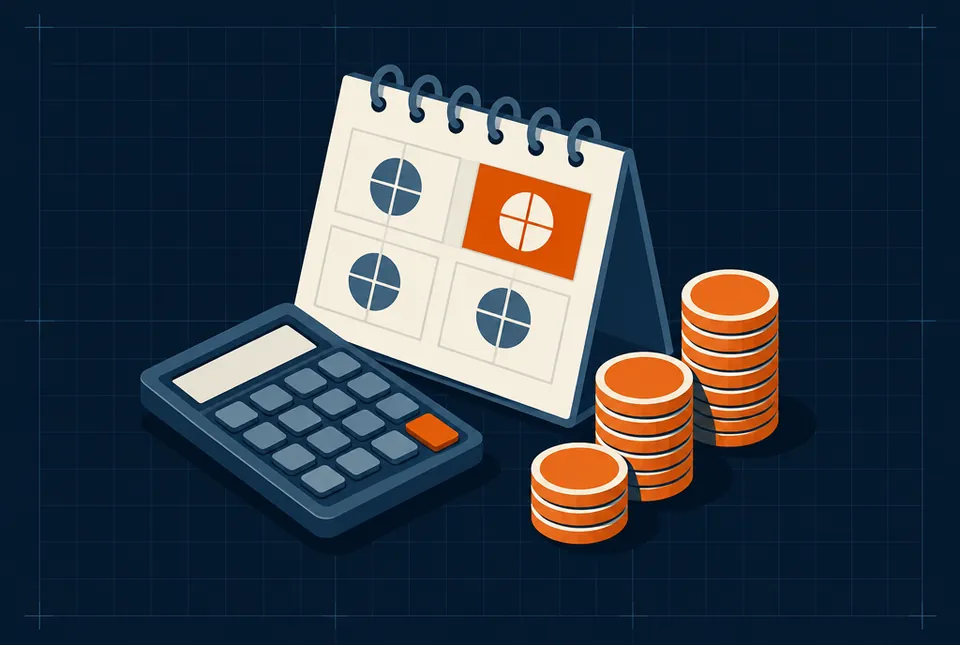
Federal estimated tax calendar, tax year 2026
- Jan 1 to Mar 31Pay by April 15, 2026.
- Apr 1 to May 31Pay by June 15, 2026.
- Jun 1 to Aug 31Pay by September 15, 2026.
- Sep 1 to Dec 31Pay by January 15, 2027.
To avoid an underpayment penalty, a common target is to pay at least the smaller of 90% of this year's tax or 100% of last year's tax. It rises to 110% if last year's adjusted gross income was above $150,000. Exceptions apply. Your state has its own estimated tax rules and dates too, and California does as well, so check with your state tax agency or CPA. A practical habit: move a fixed percentage of every customer payment into a separate tax account.
Records that back up every deduction
The IRS generally says to keep records that support a deduction until the period of limitations for that return runs out, which for most returns is 3 years (Publication 583). Longer periods apply in some cases, such as 6 years if you leave out more than 25% of your gross income, at least 4 years for employment tax records, and until the limitations period ends for the year you sell an asset. A bank statement shows you paid something, but it may not show what it was for.
A simple records system
- A separate business bank account and card, so personal spending stays out.
- Receipts, invoices and paid bills saved as you go.
- A mileage log with the date, miles and purpose of each trip.
- A job name on every expense, so you know which job it belongs to.
- A monthly check of your bank and card statements against your records.
- A folder for yearly items: insurance, license renewals and equipment purchases with the date placed in service.
One of the anonymous cases on my home page is a remodeling company that came to me with personal and business accounts mixed together. The first step was setting up its bookkeeping. If you want tax-ready books, start with our bookkeeping guide, and know that Oficina del Contratista is my accounting company.
A simple routine for the year
Do a little each month and the tax season gets much quieter. Reconcile and categorize expenses monthly, pay your estimates each quarter, ask your CPA before buying a truck or equipment, and hand over organized records at year end. If you want help seeing where you stand, the Business X-Ray reviews your numbers, taxes, payroll and operations.
Frequently asked questions
Can I deduct my truck if I also use it for personal driving?
Only the business share. The IRS says you divide expenses between business and personal use, and you can base that on miles driven for each purpose. With the standard mileage rate you cannot also deduct car insurance. Keep a mileage log, and ask your CPA which method fits your vehicle.
Do I have to pay quarterly estimated taxes?
Generally yes, if you expect to owe $1,000 or more when you file and no one withholds enough tax from your income. For tax year 2026 the dates are April 15, June 15 and September 15, 2026, and January 15, 2027. Check Publication 505 and your state's rules, or ask your CPA.
Can I deduct a customer who never paid me?
Often not, and it depends on your accounting method. The IRS says you generally cannot deduct amounts you never included in income, which describes many cash-method businesses. Bad debts have specific rules, so let your CPA decide. Preventing the problem with clear contracts and prompt invoicing is the safer path.
How long should I keep receipts and records?
Generally until the period of limitations for the return runs out, usually 3 years from filing, longer in some cases (6 years for large unreported income, at least 4 years for employment tax records). Keep records on equipment until the limitations period ends for the year you sell it.
Can I deduct meals with a customer or my crew?
Generally 50% of the cost of a business meal, including tax and tip, when you or an employee is present and the meal is not lavish. Entertainment, like event tickets, is not deductible. Write down who attended and why on the receipt, and ask your CPA about special cases.
References
- Publication 334 (2025), Tax Guide for Small Business. Internal Revenue Service (IRS). https://www.irs.gov/publications/p334 (accessed November 1, 2026)
- Publication 463 (2025), Travel, Gift, and Car Expenses. Internal Revenue Service (IRS). https://www.irs.gov/publications/p463 (accessed November 1, 2026)
- Publication 946 (2025), How To Depreciate Property. Internal Revenue Service (IRS). https://www.irs.gov/publications/p946 (accessed November 1, 2026)
- Publication 505 (2026), Tax Withholding and Estimated Tax. Internal Revenue Service (IRS). https://www.irs.gov/publications/p505 (accessed November 1, 2026)
- Publication 583 (Rev. December 2024), Starting a Business and Keeping Records. Internal Revenue Service (IRS). https://www.irs.gov/publications/p583 (accessed November 1, 2026)
Keep reading
 Bookkeeping
Construction Bookkeeping for Contractors: What to Track, Job Costing and Monthly Reports
Construction bookkeeping made simple: what records to keep, how job costing shows profit per job and the 3 monthly reports to read, in plain words.
11 min read Payroll & 1099
1099 vs. W-2 in Construction: Who Is a Subcontractor and Who Is an Employee?
1099 vs W2 contractor in construction: learn when a worker is an employee or a subcontractor, what California requires and the mistakes that cost the most.
11 min read Payroll
Contractor Payroll 101: How to Pay Employees in a Construction Company
Contractor payroll made simple: set up new employees, know what gets withheld and who pays what, cover workers' comp and avoid the risks of paying cash.
10 min read