How Much Does a General Contractor Make? (And How Much Should You Keep?)
How much does a general contractor make? See BLS pay data, NAHB profit margins and a 4-step way to find what your company really keeps after costs.
 By Armando Ehrenzweig10 min read

Contents
- How much does a general contractor make? Three different answers
- What BLS says about construction managers' pay
- What the company keeps: profit margins from NAHB data
- Sales are not profit: an illustrative example
- Owner pay vs. company profit: do not mix them
- Three leaks that shrink your profit
- How to find your own number in four steps
- Frequently asked questions
- References
- There is no single answer: employee pay, company profit and owner pay are three different numbers from three different sources.
- BLS reports a 2025 median wage of $114,990 for construction managers, but that covers employees, not self-employed owners.
- In NAHB studies, single-family builders averaged an 8.7% net margin and remodelers 6.3%, with a huge gap between top and bottom firms.
- Sales are not profit: in our illustrative example, $1,000,000 in sales leaves only $30,000 of profit after costs and an owner salary.
- Treat your own pay as a cost first, measure profit after it, and ask a CPA how to structure owner pay.
- Find your real number in four steps with 12 months of actual sales and costs, then price jobs from cost with the margin you need.
How much does a general contractor make? There is no single number, because people use that question for three different things: a manager's paycheck, the profit a company keeps, and what the owner actually takes home. Mixing them up is how contractors with big sales end up with an empty bank account. Here is what official and industry sources say, what they leave out, and how to find your own number.
How much does a general contractor make? Three different answers
Each version of the question has its own source and its own meaning, so separate them first.
| What people mean | What it is | Where a real number comes from |
|---|---|---|
| Employee pay | A paycheck for managing projects at someone else's company | Government wage data (BLS) |
| Company profit | What the company keeps after every cost, including a pay line for the owner | Industry studies, such as NAHB's |
| Owner pay | What you actually take out: salary, draws, profit left in the company | Your own books |
A close match in BLS data is "construction managers," so that is the category used below.
What BLS says about construction managers' pay
The U.S. Bureau of Labor Statistics (BLS) is the standard source for wages by occupation. For construction managers it reports a median annual wage of $114,990 for 2025, about $55.28 an hour. Median means half of the workers earn more and half earn less.
Construction managers: annual wages (BLS, 2025)
- $114,990Median: half earn more, half earn less
- $69,690The lowest-paid 10% earned less than this
- $189,440The highest-paid 10% earned more than this
Source: BLS Occupational Outlook Handbook. Wages of employees only.
Two cautions. First, these are wages of people on a payroll. The BLS wage survey leaves out the self-employed and the owners of unincorporated firms, so it does not show what business owners keep. Second, a salary and an owner's income are different things: the owner carries the risk, the payroll, the slow months and the taxes.
What the company keeps: profit margins from NAHB data
For company profit, a well-known public benchmark in residential construction is the Cost of Doing Business studies from the National Association of Home Builders (NAHB). They rely on financial statements that builders and remodelers send to NAHB, so they describe the firms that took part, not every contractor in the country.
| Group (NAHB study) | Gross margin | Operating expenses | Net margin |
|---|---|---|---|
| Single-family builders, fiscal 2023 | 20.7% | 12.0% | 8.7% |
| Remodelers, 2024 | 29.9% | 23.6% | 6.3% |
Gross margin is what is left of sales after direct job costs: labor, materials and subcontractors. Operating expenses are everything else the company spends, and NAHB lists the owner's compensation among them. Net margin is what remains after both.
Averages hide the spread. In the builders' study, the top 25% of firms averaged a 17.7% net margin, while the bottom 25% averaged a loss.
Builders' net margin by group (NAHB, fiscal 2023)
- 17.7%Top 25% of builders
- 8.7%Average of all builders
- -1.4%Bottom 25%: an average loss
Do not read these as your target or a promise. They are what participating firms reported in those years, and NAHB itself expected builders' margins to shrink in 2024. Roofing, electrical, concrete and other trades have different cost structures. We do not quote margins for other trades or for commercial work because we did not find a public source we could verify.
Sales are not profit: an illustrative example
This is why a company can sell a lot and still feel broke. The numbers below are an illustrative example, not an average of the industry.
Illustrative example: where each $100 of sales goes
- Materials$28
- Job labor$30
- Subcontractors$20
- Overhead$14
- Owner's salary$5
- Profit left$3
Illustrative example only. 28 + 30 + 20 + 14 + 5 + 3 = 100.
On $1,000,000 of sales, that is $280,000 in materials, $300,000 in job labor, $200,000 in subcontractors, $140,000 in overhead (office, insurance, vehicles, software), $50,000 for the owner's salary and $30,000 of profit. Direct costs total $780,000, so the gross profit is $220,000, or 22% of sales.
The owner's pay plus the profit comes to $80,000, or 8% of sales. But the real profit is only $30,000, or 3%. One job that needs rework, or one client who pays 90 days late, can wipe it out.
Owner pay vs. company profit: do not mix them

When you pay yourself a salary for the work you do (estimating, selling, managing), that is a cost of doing business, just like paying any other manager. Profit is what is left after that line. It belongs to the company to build a cash cushion, buy equipment or be distributed.
If you skip the salary line, your "profit" is really your wages, and the business looks healthier than it is. NAHB, for example, counts owner's compensation inside operating expenses, so in its numbers net margin is measured after that line.
How an owner can be paid depends on the legal structure of the company (sole proprietor, LLC, S corporation or C corporation) and on tax rules that change. Salary, draws and distributions are taxed differently, and the right mix is different for every business. Armando is not a CPA or an attorney: this is general education, not tax or legal advice. Ask a licensed CPA or tax professional about your own case.
Three leaks that shrink your profit
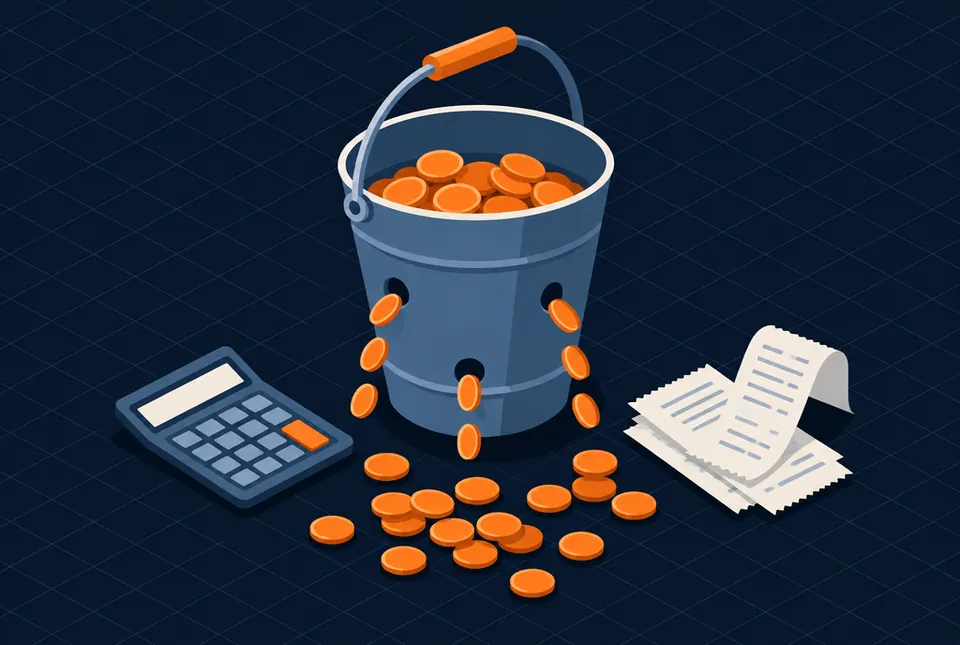
- Overhead that is not in the estimate. If your price only covers materials and labor, rent, insurance, software, vehicles and your own time come out of profit. See how to build them into the price in our estimate template guide.
- Rework and extra work with no change order. Fixing mistakes or doing "just one more thing" without charging for it spends labor and materials you never get paid for.
- Money that is not yours, in your account. Payroll taxes, sales tax and income tax set-asides are not profit. If they sit in the same account and get spent, the bill arrives later. Good bookkeeping keeps them visible.
How to find your own number in four steps
You do not need a perfect system, only twelve months of real numbers from your books or bank statements.
Your profit in four steps
- Add up 12 months of salesUse real income, not estimates or what you "usually" sell.
- Subtract direct job costsMaterials, job labor and subcontractors. The result is gross profit; divide it by sales for your gross margin.
- Subtract overhead and a fair salary for yourselfOffice, insurance, vehicles, software, admin and pay for the work you do.
- Read what is leftThat is company profit. Divide by sales for your net margin and compare year to year.
Once you know the margin you need, price new jobs from cost: price = cost ÷ (1 − margin). Illustrative example: if a job costs $90,000 including overhead and you want a 10% margin, the price is $90,000 ÷ 0.90 = $100,000, which leaves $10,000 of profit. That is a 10% margin but an 11.1% markup on cost ($10,000 ÷ $90,000), which is why mixing up the two terms makes jobs underpriced.
If your books cannot give you these four numbers, that is the first thing to fix. Oficina del Contratista, Armando's accounting company, works with contractors on exactly that, and you can also book a 1-on-1 consultation to review them together. Just starting out? Read how to start a construction company first, see our services or contact Armando, who works in English and Spanish.
Frequently asked questions
How much does a general contractor make per year?
It depends on whether you mean employee pay or business profit. BLS reports a median wage of $114,990 for construction managers in 2025, but that covers employees only. A company owner's income depends on sales, margins and how the owner is paid. In NAHB's studies, average net margins were 8.7% for single-family builders (fiscal 2023) and 6.3% for remodelers (2024).
What is a good profit margin for a contractor?
There is no single answer, and we cannot give you a target without knowing your trade, market and size. NAHB's averages are 8.7% net for single-family builders and 6.3% for remodelers, but the top 25% of builders earned far more and the bottom 25% lost money on average. Use those figures as context, then track your own margin job by job.
Is profit the same as what the owner takes home?
No. The owner can take a salary for the work they do, which is a cost, and the company can keep or distribute profit on top of it. In your books these should be separate lines. If you only look at what you took out of the bank, you cannot tell whether the company itself made money.
What is the difference between gross margin and net margin?
Gross margin is sales minus direct job costs (labor, materials, subcontractors), divided by sales. Net margin is what remains after overhead and other operating expenses are also paid, divided by sales. A company can have a healthy gross margin and still end with a small net margin if overhead is too high.
Where can I look up wages for my own area?
BLS publishes occupational wage estimates by state and metro area through its Occupational Employment and Wage Statistics (OEWS) program. Search for "construction managers" there. Remember that it counts employees on payrolls only, so it will not tell you what a contractor who owns the company keeps.
References
- Construction Managers: Occupational Outlook Handbook. U.S. Bureau of Labor Statistics. https://www.bls.gov/ooh/management/construction-managers.htm (accessed November 1, 2026)
- Occupational Employment and Wages Technical Note, May 2025. U.S. Bureau of Labor Statistics. https://www.bls.gov/news.release/ocwage.tn.htm (accessed November 1, 2026)
- Builders' Profit Margins Improved in 2023. NAHB Eye on Housing. https://eyeonhousing.org/2025/03/builders-profit-margins-improved-in-2023/ (accessed November 1, 2026)
- How Key NAHB Financial Growth Data Can Help Your Business. NAHB. https://www.nahb.org/blog/2025/07/how-key-nahb-financial-growth-data-can-help-your-business (accessed November 1, 2026)
- Remodelers Saw Profit Margin Gains in 2024. NAHB Eye on Housing. https://eyeonhousing.org/2026/04/remodelers-saw-profit-margin-gains-in-2024/ (accessed November 1, 2026)
Keep reading
 Estimating
Construction Estimate Template (Free) + How to Price Jobs Without Losing Money
Download a free construction estimate template and learn how to price jobs: the 5 numbers, markup vs margin and a worked example that protects your profit.
10 min read Bookkeeping
Construction Bookkeeping for Contractors: What to Track, Job Costing and Monthly Reports
Construction bookkeeping made simple: what records to keep, how job costing shows profit per job and the 3 monthly reports to read, in plain words.
11 min read Starting out
How to Start a Construction Company: A 10-Step Checklist for New Owners
Learn how to start a construction company in 10 steps: structure, EIN, license, insurance, bank account, pricing and a simple 90-day plan, in plain English.
10 min read